
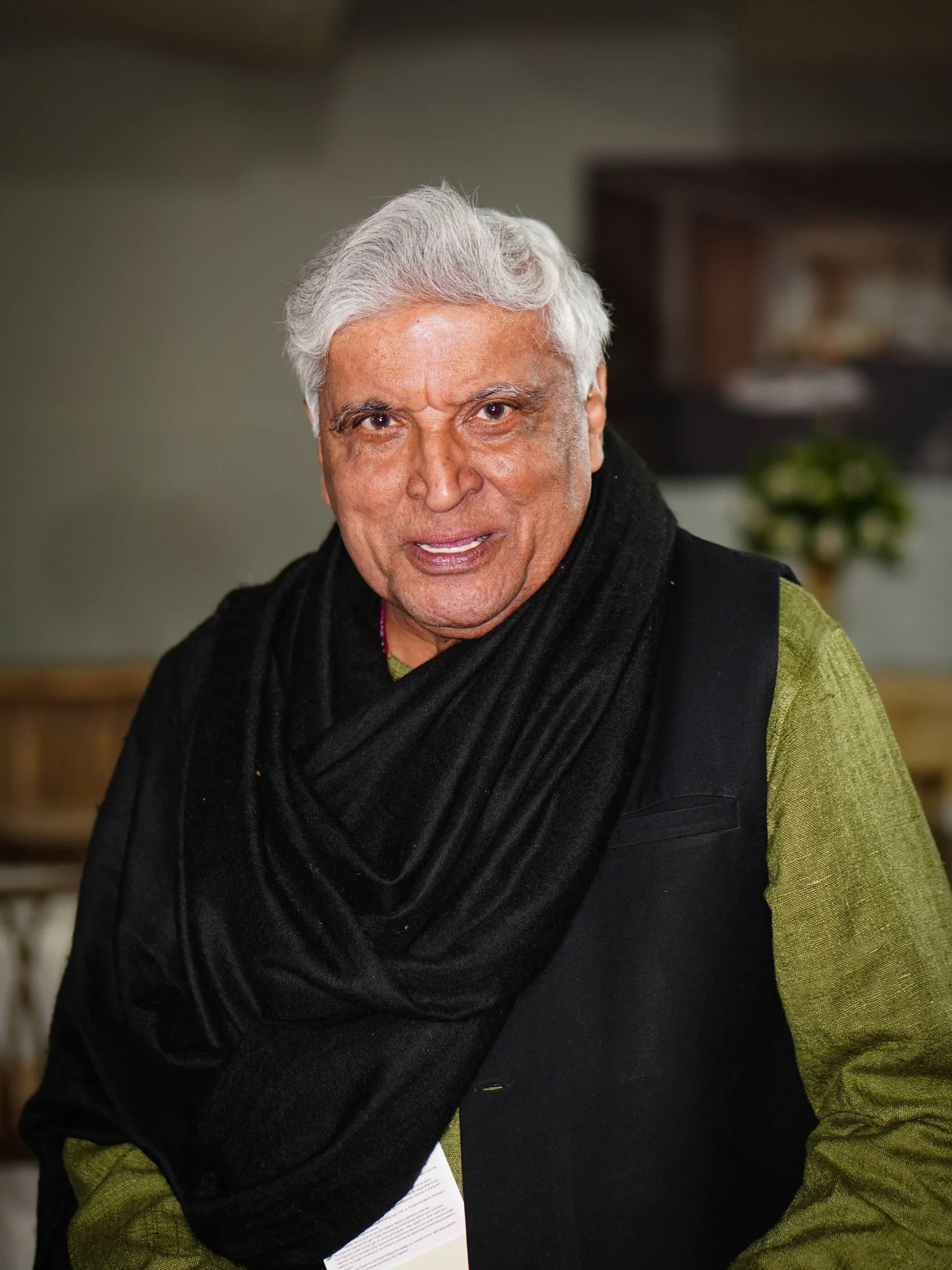
Javed Akhtar: A Life Written in Words, Stories and Ideas
From the timeless dialogues of Indian cinema to the enduring beauty of Urdu poetry, Javed Akhtar’s journey shows that words can travel farther than the people who write them.
Some people’s work becomes so deeply woven into our lives that we recognise their words long before we recognise their faces. Their dialogues become part of everyday conversation, their songs accompany our journeys, and their poetry expresses emotions we struggle to explain. Javed Akhtar is one such figure in Indian cultural life.
At the Jaipur Literature Festival 2026, I had the opportunity to meet him. Speaking with a writer whose words have reached generations of readers, cinema lovers and listeners made me reflect on a remarkable journey, and on an influence that extends far beyond entertainment.
A Writer Who Changed the Language of Indian Cinema
Javed Akhtar was born on 17 January 1945 in Gwalior and grew up in a literary environment. His father, the renowned Urdu poet Jan Nisar Akhtar, and his mother, the writer Safia Akhtar, came from a family with deep literary roots. Yet Javed Akhtar’s contribution to Indian culture would develop a distinctive identity of its own.
His rise to prominence as one half of the celebrated screenwriting duo Salim–Javed changed the role of the writer in Hindi cinema. During the 1970s, the pair wrote influential films including Zanjeer, Deewaar and Sholay. Their storytelling shaped a new kind of cinematic hero, the “angry young man”, and proved that a powerful screenplay could be as memorable as the performances on screen.
From unforgettable confrontations to lines that entered popular culture, their writing gave Indian cinema characters with conviction, conflict and a distinctive voice. The legacy of Salim–Javed remains an important chapter in the evolution of commercial Hindi filmmaking.
After the partnership ended in the early 1980s, Akhtar continued to build his career as a lyricist and screenwriter, working on films for different generations of audiences. His career shows how storytelling can evolve with changing audiences while retaining its emotional power.
The Poet Behind the Screenwriter
Cinema introduced Javed Akhtar to millions, but poetry reveals another dimension of his creative world.
His poetry collection Tarkash brought together nazms and ghazals shaped by reflection, memory, relationships and the complexities of human experience. His later collection Lava further established his standing as a literary voice beyond the film industry, and it earned him the Sahitya Akademi Award. He has also received the Padma Shri and the Padma Bhushan.
Akhtar’s lyrics have a rare ability to make complicated emotions feel accessible. Love, separation, hope, uncertainty and the passage of time are familiar themes, yet their expression depends on a writer’s sensitivity to language and rhythm.
For a traveller and storyteller, this relationship between words and emotions is especially interesting. A journey is not simply a movement from one destination to another. It is an accumulation of experiences, encounters and memories that gradually change the way we see the world. Poetry performs a similar function: it gives meaning to moments that might otherwise pass unnoticed.
Akhtar’s work reminds us that language is more than a means of communication. It can preserve a feeling, reveal a contradiction and connect strangers through shared experience.
Meeting Javed Akhtar at the Jaipur Literature Festival 2026
The Jaipur Literature Festival is more than a celebration of books. It is a meeting place for writers, thinkers, artists and readers from different backgrounds, bringing together perspectives that might never otherwise meet.
Meeting Javed Akhtar there connected my own interest in storytelling with the work of a writer whose words have travelled across generations. As someone building Nomad Vikas around travel, culture and stories, I find it meaningful to meet people whose creative contributions extend beyond a single profession or medium.
Travel teaches us to look beyond the familiar. It introduces us to different cultures, histories and ways of thinking. Literature offers another route into that wider world. A book can take us into another person’s experience, while a poem can help us reconsider something we thought we already understood.
The significance of meeting a writer like Akhtar lies in recognising the person behind a body of work that has become part of the cultural landscape. My encounter at the 2026 festival became a moment worth recording as part of my own journey through India’s literary and cultural spaces.
Beyond Cinema: Language, Society and Independent Thought
Javed Akhtar’s public life has also extended into discussions about language, social values and secularism. He has consistently engaged with questions about India’s plural society, the importance of reason and the relationship between culture and public life.
His literary background is especially relevant to these conversations. Urdu, Hindi and the wider linguistic traditions of the subcontinent have developed through centuries of exchange, borrowing and shared cultural experience. Their histories show that languages are living traditions, shaped by the people who use them.
For Akhtar, the written and spoken word is not confined to artistic expression. It is also a way of taking part in society, questioning assumptions and examining the ideas that shape public life.
This breadth of engagement is part of what makes his career so compelling. He is not simply a screenwriter remembered for successful films or a lyricist associated with popular songs. He is also a poet and public intellectual whose work invites discussion well beyond cinema.
Why Javed Akhtar’s Journey Matters to a New Generation of Storytellers
In an age of short videos, fast-changing trends and endless digital content, the craft of storytelling deserves renewed attention.
A memorable story does not require elaborate language or a grand setting. It requires an understanding of people: what they want, what they fear, what they remember and what they are willing to sacrifice. Strong writing gives these experiences shape and makes them meaningful to an audience.
Javed Akhtar’s career shows how one fundamental skill can find expression in different forms. A screenplay creates a world through characters and conflict. A song compresses an emotion into a few minutes. A poem can make a single observation feel universal.
For those of us documenting places and people through travel films, photography, writing and digital storytelling, this is an important lesson. A destination may attract attention for its architecture, landscape or history, but the stories of the people who live there give it depth.
The challenge is to look carefully, listen closely and tell a story honestly. That principle applies equally to a film, a poem, a travel documentary or an editorial.
The Words That Continue to Travel
Some writers are remembered for the books they publish. Others are remembered for the characters they create, the songs they write or the conversations they inspire. Javed Akhtar’s career brings all of these together.
His work in Hindi cinema has reached audiences across generations, while his poetry continues to hold a space of its own. His journey shows that creative work can move between popular culture and literature without losing its power to make people think and feel.
My meeting with him at the Jaipur Literature Festival 2026 is part of my continuing exploration of the people, ideas and cultural experiences that make India such a compelling place to discover.
At Nomad Vikas, I believe every journey offers more than a destination, and every meaningful encounter has the potential to become a story. Some stories are found on unfamiliar roads; others emerge through conversations, books, films and the people whose work shapes our understanding of the world.
Javed Akhtar’s life and work remind us that words can outlive the moment of their creation. They can travel across borders, generations and changing times, finding new meaning in the lives of those who encounter them.
And perhaps that is one of the most enduring qualities of a storyteller: the ability to leave something behind that keeps travelling long after the original moment has passed.